

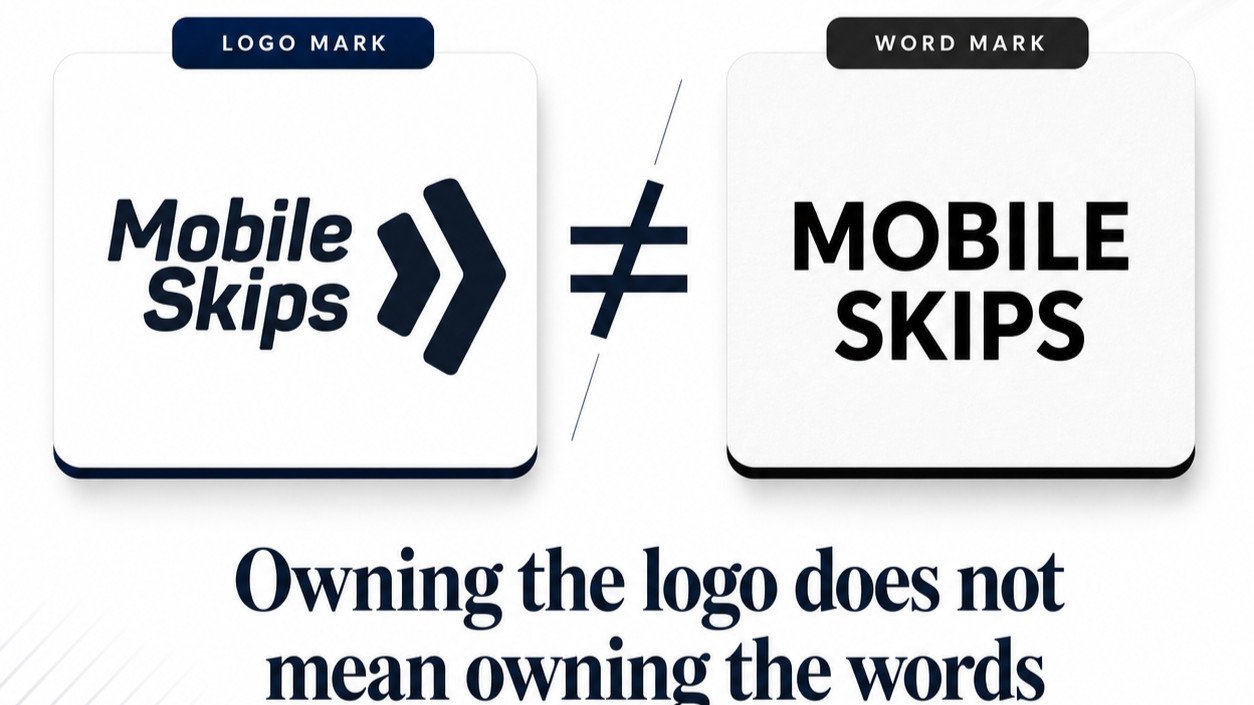
The Federal Court’s decision in Mobile Skips (Australia) Pty Ltd v Registrar of Trade Marks [2026] FCA 744 is a timely reminder that a registered logo mark does not necessarily give the owner exclusive rights in the words appearing within that logo.
A business may own a stylised mark. It may have used that mark for many years. It may even be known in the market by the words appearing in that mark. But if those words are descriptive, the words alone may still fail under the Trade Marks Act 1995 (Cth) (the Act).
That is exactly what happened in Mobile Skips.
What happened in this case?
Mobile Skips sought to register the plain word mark ‘MOBILE SKIPS’ for services relating to skip bin hire and waste collection.
The Applicant already owned three composite trade mark registrations incorporating the words ‘Mobile Skips’. Those registrations were not for the words alone. They included stylisation, colour, chevrons and other visual elements: Search Results | IP Australia | Trade Mark Search
The Registrar refused the plain word mark application under s 41 of the Act, on the basis that ‘MOBILE SKIPS’ was not capable of distinguishing the Applicant’s services from the services of other traders.
Mobile Skips appealed under s 35 of the Act. The appeal was dismissed.
Why did the mark fail?
Section 41(1) of the Act provides that an application must be rejected if the trade mark is not capable of distinguishing the applicant’s goods or services from those of other persons.
That inquiry is tied to the essential function of a trade mark under s 17 of the Act, namely to distinguish one trader’s goods or services from those of others.
The Court considered whether ‘MOBILE SKIPS’ was inherently adapted to distinguish, as required by s 41(3) of the Act. In doing so, the Court applied the familiar principles from Clark Equipment Co v Registrar of Trade Marks (1964) 111 CLR 511 and Cantarella Bros Pty Ltd v Modena Trading Pty Ltd (2014) 254 CLR 337.
The key question was whether other traders, acting honestly, would have a legitimate desire to use the same or similar words to describe their own services.
The answer was yes.
The words ‘mobile’ and ‘skips’, used together, conveyed the idea of skips that are mobile, movable or trailerable. That meaning was directly connected with the services at issue. The words were not allusive or suggestive. They described the offering.
That meant that ‘MOBILE SKIPS’ did not do enough work as a trade mark.
The logo did not save the words
This is the central lesson, in my opinion, for brand owners.
A composite logo mark may be registrable because of its overall impression. Colour, layout, stylisation, device elements and graphic features may together create a distinctive mark.
But that does not mean the words inside the logo are separately registrable. A logo registration is not a backdoor monopoly over descriptive words.
In Mobile Skips, once the chevrons, colours and stylisation were stripped away, what remained was a descriptive expression. The Applicant could not rely on the distinctiveness of its composite marks to rescue the plain word mark.
Long use was not enough
The Applicant also relied on its use of the mark over approximately 16 years, together with evidence of trading history and market presence.
However, acquired distinctiveness is not established by use alone.
For a descriptive sign, the evidence must show that the sign applied for has, because of use, come to distinguish the applicant’s services as a trade mark. It is not enough to show that the business is successful, that consumers have encountered the words, or that the words appear somewhere in the applicant’s branding.
The difficulty for Mobile Skips was that much of the evidence showed use of composite device marks, not use of ‘MOBILE SKIPS’ as a plain word mark.
Use of a logo may, in some cases, support acquired distinctiveness in the words. But it will not automatically do so. The evidence must show that consumers see the words themselves as the badge of origin.
Website use, domain name use, traffic data and online recognition may be relevant, but they are not a substitute for evidence that the words function as a trade mark.
A disclaimer was not the answer
Mobile Skips also sought to rely on s 74 of the Act.
In practical terms, it wanted ‘MOBILE SKIPS’ to proceed to registration with a disclaimer. That is, the Applicant sought to address the descriptiveness concern by accepting that it would not have exclusive rights in particular descriptive components of the mark, such as ‘mobile’ or ‘skips’, separately.
The difficulty was that this did not answer the s 41 objection.
A disclaimer may be appropriate where an otherwise registrable mark contains a descriptive or non-distinctive element. It can make clear that the owner does not obtain exclusive rights in that element by itself.
But a disclaimer does not make an otherwise unregistrable mark registrable.
In Mobile Skips, the problem was not that a distinctive mark contained one descriptive component that could be carved out. The problem was that the whole mark applied for, ‘MOBILE SKIPS’, was descriptive of the services and lacked capacity to distinguish.
There was no distinctive remainder to preserve.
That is why s 74 could not assist. It could not be used to sidestep the threshold requirement in s 41 of the Act.
For brand owners, the point is important: a disclaimer can limit the scope of rights in a registrable mark. It cannot create distinctiveness where the mark itself does not have it.
Key takeaways for brand owners
The decision is a warning against assuming that commercial recognition equals legal distinctiveness.
For brand owners, the practical takeaways are clear.
- File the word mark early if the words matter: If the words are intended to be the core brand, assess whether they can be protected before investing heavily in them.
- Do not assume a logo registration protects the words alone: A composite logo registration protects the mark as registered. It may not give meaningful protection against use of the words in plain form.
- Descriptive names are harder to monopolise: Names that tell consumers what the product or service is may be commercially attractive, but they are often weak from a trade mark perspective.
- Use evidence must match the mark applied for: If the application is for a word mark, the evidence should show use of the words as a trade mark, not just use of a logo, business name, domain name or descriptive phrase.
- A disclaimer will not rescue a non-distinctive mark: Section 74 of the Act cannot be used to sidestep the threshold requirement in s 41.
- Think carefully before enforcing a logo registration against word use: A logo registration may assist against similar branding or get-up, but it may be much less useful against descriptive use of similar words.
Why it matters
Descriptive branding is tempting. It is clear, searchable and easy for consumers to understand.
But the more directly a brand describes the goods or services, the harder it will be to claim exclusive rights in it.
That is not a technicality. It is a policy choice built into trade mark law. Other traders should remain free to use ordinary language to describe their own goods and services.
Mobile Skips is not just a case about skip bins. It is a case about the boundary between branding and language.
The lesson is simple: You may own the logo and you may have used it for years. You may even be known by the words inside it.
But if the words alone describe the goods or services, they may not survive scrutiny under s 41 of the Act.
A logo registration may protect the badge as a whole. It does not necessarily give you the words.
Read the full decision here: Mobile Skips (Australia) Pty Ltd v Registrar of Trade Marks [2026] FCA 744 (16 June 2026)


